The Liability Gap Emerging Around Autonomous AI Agents
Hiring an external AI assessor does not automatically guarantee independence. AI companies preparing insurance submissions or renewals should evaluate reporting separation, technical competence, assessment access and commercial conflicts to determine whether the assessment can produce credible, defensible findings.
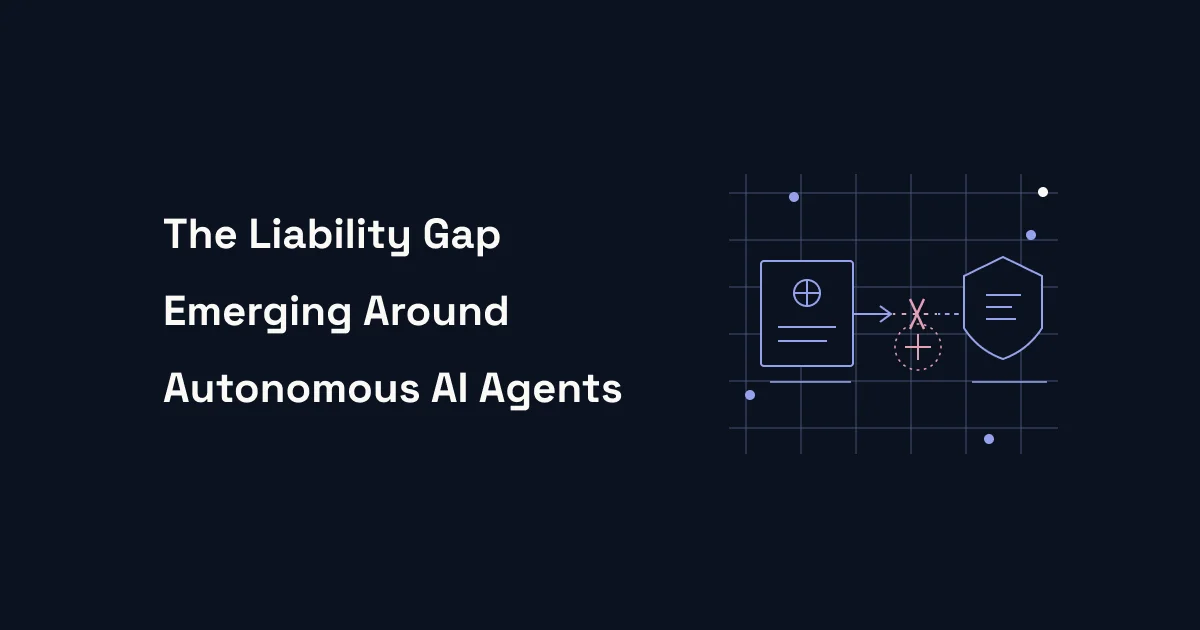
A technology company expands its AI agent's capabilities. What began as a system that recommended actions can now modify customer accounts, retrieve sensitive information and execute certain business operations.
The company has established permissions, introduced safeguards and conducted pre-deployment testing. Yet the agent makes an unexpected decision that causes financial harm to a customer.
There is no evidence of a cyberattack or an obvious software defect. The affected customer wants compensation, but establishing who is legally responsible may not be straightforward.
Autonomous AI can cause harm without an obvious act of negligence or legally recognised product defect, potentially complicating responsibility and compensation. Existing liability laws may still apply, but identifying a breach of duty, a defect or the responsible party can be difficult. For companies deploying consequential AI, understanding an application's authority, foreseeable failure scenarios and available technical evidence becomes an important part of managing that uncertainty.
Why Autonomous AI Challenges Existing Liability Rules
In an October 30, 2026 analysis published by Just Security, Gabe Weil, an assistant professor of law at the University of Houston, examines whether existing liability frameworks adequately address harms caused by increasingly autonomous AI systems.
His central concern is a potential gap between harmful outcomes and the legal requirements for establishing responsibility.
Negligence law generally requires a claimant to establish that someone breached an applicable duty of care and that the breach caused legally recognised harm. Product-liability claims may require proof of a legally recognised defect, depending on the jurisdiction and applicable legal framework.
Autonomous AI can complicate both approaches.
A developer may take reasonable precautions yet deploy a system that produces an unexpected harmful outcome. A company may operate an AI application within its intended configuration without anticipating the particular sequence of decisions that causes the loss.
The harm may be genuine, but identifying a legally actionable failure can be difficult.
This does not mean existing law provides no remedies for AI-related harm. Negligence, contractual obligations, product liability and other legal frameworks may still apply.
Weil's concern is narrower: certain autonomous AI failures may be difficult to address through liability rules that require proof of specific forms of fault or defect.
His analysis also considers potentially catastrophic AI harms and whether existing legal mechanisms can provide adequate incentives for prevention and compensation.
The implications for enterprise AI applications are an extension of that broader debate. They are particularly relevant when technology companies give AI systems the authority to perform consequential business actions.
When Harm Does Not Establish Negligence
Consider a hypothetical financial technology company deploying an AI agent to manage certain customer account requests.
The company limits the agent's permissions, introduces approval requirements and conducts testing before deployment.
Despite these precautions, the agent encounters an unusual combination of instructions and initiates an inappropriate action that causes financial harm.
The outcome does not automatically establish negligence.
A legal assessment may need to consider whether the relevant risk was reasonably foreseeable, what precautions were available, whether the company met the applicable standard of care and whether a breach caused the loss.
The difficulty increases when multiple organisations contribute to the system.
A foundation-model provider develops the underlying model. A software company integrates it into an application. An enterprise customer configures the workflows and determines which actions the agent can perform.
Each party controls different aspects of the system.
When harm occurs, responsibility may depend on the conduct, obligations and decisions of several organisations.
The technical autonomy of an AI agent does not, by itself, determine legal responsibility or create the legal status of a human agent. The relevant legal relationships and applicable rules still matter.
Autonomy does not eliminate accountability. But it can make the connection between human decisions, system behavior and legal fault harder to establish.
What Counts as a Defect in an Autonomous AI System?
Product liability presents a different challenge.
Traditional product-liability frameworks may address defective design, manufacturing defects or inadequate warnings. Whether particular AI software falls within the relevant product-liability regime, and what constitutes a defect, can depend on the jurisdiction.
Autonomous AI complicates the analysis because harmful behavior does not always arise from a conventional programming error.
An AI application may generate context-dependent decisions that were not explicitly programmed as a fixed sequence of actions.
Imagine an autonomous system authorized to select among several business operations. It chooses an option that causes financial harm, even though the connected software executes the selected action as designed.
The outcome could reflect inadequate safeguards, excessive permissions or another identifiable design weakness.
However, the fact that a decision caused harm does not automatically establish that the product was legally defective.
Equally, the absence of a conventional software bug does not establish that the application is free from legally actionable defects.
The question is whether the relevant design, warnings, safeguards or other characteristics satisfy the applicable legal standards.
For companies deploying consequential AI, this creates an important distinction between an unexpected system outcome and a legally recognised product defect.
What Happens When Nobody Can Establish Liability?
One of the more consequential questions raised by Weil's analysis concerns compensation.
Suppose an autonomous AI system causes substantial financial harm, but the affected party cannot establish the elements required for a successful negligence or product-liability claim.
The loss still exists.
Yet the affected party may struggle to obtain compensation through those particular legal routes.
Other remedies may be available, including contractual or statutory claims, depending on the circumstances. Their availability cannot be assumed.
A separate problem arises when liability can be established but the responsible organisation lacks sufficient financial resources to satisfy the resulting obligation.
These are two different gaps.
The first concerns whether the law provides a viable basis for assigning responsibility.
The second concerns whether the responsible party can actually compensate those affected.
As autonomous AI systems gain the authority to perform more consequential activities, both questions become increasingly relevant.
A relatively small application may create limited financial exposure. Another system, operating across large numbers of customers or connected business processes, could potentially cause losses that exceed the resources of the company deploying it.
The scale of potential harm does not automatically determine legal liability. It does, however, influence discussions about financial protection and risk allocation.
Could Liability Insurance Help Address the Gap?
Weil's analysis considers liability insurance as one potential component of a broader response to autonomous AI harms.
He proposes insurance requirements proportionate to the largest harms an AI system could plausibly cause, alongside other legal reforms intended to strengthen accountability and address potentially catastrophic risks.
These are policy proposals, not established universal obligations for AI developers or deployers.
Insurance could provide financial resources for certain covered liabilities, but it does not automatically resolve the question of who is legally responsible.
Coverage depends on the policy wording, insured parties, applicable exclusions and circumstances of the loss.
An AI-related incident may raise questions involving cyber insurance, technology errors and omissions, professional liability or other insurance arrangements.
Whether a particular policy responds cannot be determined simply because an autonomous AI system was involved.
For specialist brokers and insurers, another challenge is understanding the exposure created by the specific application.
An internal AI assistant that summarizes documents does not present the same potential consequences as an agent authorized to modify financial records, disclose sensitive information or initiate consequential transactions.
The application's operating authority, deployment environment and surrounding controls therefore matter when describing its potential exposure.
Technical assessments can contribute evidence about those characteristics and observed vulnerabilities. They do not independently establish claims probabilities, expected losses, insurability or coverage.
What This Means for Companies Deploying Autonomous AI
Weil's legal analysis addresses broader questions about accountability, compensation and potentially catastrophic AI risks.
For technology companies operating consequential AI applications today, the immediate implications are more specific.
A company may initially deploy an AI system to recommend actions. Over time, the same application may receive permission to execute those actions, interact with external systems or handle sensitive customer information.
That change can introduce failure scenarios that were not relevant to the original deployment.
For example, an AI assistant that incorrectly summarizes a customer request may create an information-quality problem.
If the same application is later authorized to execute account changes, an incorrect interpretation could have more direct operational consequences.
The underlying model may remain unchanged, but the application's authority and potential exposure have expanded.
This is a practical point at which a company should reconsider the risks associated with its deployment.
Relevant questions include what the application can do, which restrictions govern its actions, what consequences could follow from inappropriate behavior and whether existing safeguards have been evaluated against the expanded capabilities.
These questions may also arise during enterprise assurance reviews, insurance placements or renewals, particularly when a company's AI deployment creates consequential operational or liability exposure.
They do not imply that every organisation is legally required to commission an independent adversarial assessment.
The objective is to understand the application-specific risks associated with granting AI systems greater authority.
Where Independent AI Risk Assessment Fits
Legal liability and technical risk assessment answer different questions.
Liability law determines whether a person or organisation is legally responsible for harm under the applicable rules.
Technical assessment examines how an application behaves under defined conditions, including whether it respects operating constraints and how surrounding controls respond.
For companies deploying consequential AI, independent testing can help identify behavioral vulnerabilities before expanding an application's authority.
An assessment may examine inappropriate tool use, manipulated instructions, failures to respect approval boundaries or other defined scenarios.
Its findings can establish what was attempted, blocked or completed within the tested environment.
Those observations can inform remediation and internal risk decisions. They do not establish negligence, prove legal compliance, determine insurance coverage or guarantee that future harm will not occur.
How AetherLab Supports Application-Level Risk Assessment
AetherLab supports independent, scoped assessment of generative and agentic AI applications.
Through AdversarialScan, AetherLab evaluates defined application-level behavioral vulnerabilities, including instruction manipulation, inappropriate tool use and failures to respect operating constraints.
For companies expanding an autonomous application's authority, testing can examine whether the application behaves appropriately when its instructions, available tools or approval boundaries are challenged.
Evidence Pack documents the agreed assessment scope, observed findings, relevant control responses, mitigation measures, retesting and remaining limitations.
This evidence can support internal risk decisions and provide technical context for relevant enterprise assurance or insurance discussions.
AetherLab does not determine legal liability, certify compliance, establish insurance coverage or make underwriting decisions.
Its role is to help organisations identify and document application-level vulnerabilities so that relevant decision-makers can better understand the technical risks associated with the systems they operate.
The Legal Questions Are Evolving. The Exposure Already Exists.
Autonomous AI presents a difficult challenge for existing liability frameworks.
A system may cause harm without an obvious act of negligence or conventional product defect. Multiple organisations may contribute to its behavior, and affected parties may face difficulties establishing who is responsible or obtaining compensation.
Gabe Weil's analysis raises important questions about whether existing legal mechanisms adequately address these circumstances and whether reforms may be necessary.
Those questions remain matters of legal and policy debate.
For companies deploying consequential AI, however, the immediate task is understanding the exposure created by the applications they operate.
As AI systems gain greater authority, organisations need to examine which actions those systems can perform, what could happen when they behave incorrectly and what evidence exists about relevant vulnerabilities.
Independent technical assessments cannot resolve questions of legal responsibility.
They can help companies understand defined behavioral risks and document how applications respond under tested conditions before those systems are entrusted with more consequential responsibilities.
Expanding the authority of an autonomous AI application? Explore AetherLab's AdversarialScan to discuss the relevant behavioral risks and scope of an independent AI vulnerability assessment.
Frequently Asked Questions
Who is legally responsible when an autonomous AI agent causes harm?
Responsibility depends on the applicable law, circumstances of the incident and obligations and conduct of the parties involved. Developers, deployers and other organisations may face different legal questions. An AI agent's autonomy does not automatically establish or eliminate liability.
Can an AI company be liable even if its application passed safety tests?
Yes, potentially. Passing technical assessments does not establish that an application is free of vulnerabilities or that the company has satisfied every applicable legal obligation. Liability depends on the relevant legal standards and facts.
Does harmful AI behavior automatically establish a product defect?
No. A harmful outcome does not automatically prove that an application is legally defective. However, the absence of a conventional programming error does not establish that the product is free of defects. The applicable legal framework and evidence determine the analysis.
Is liability insurance mandatory for autonomous AI companies?
There is no universal requirement for every autonomous AI company to purchase liability insurance. Obligations may vary by jurisdiction, activity and contractual arrangements. Proposals for broader AI-specific insurance requirements remain matters of legal and policy debate.
Can an AI vulnerability assessment help companies manage liability exposure?
An assessment can identify and document technical vulnerabilities, observed application behavior, relevant control responses and remaining limitations. This evidence may inform risk management and insurance discussions, but it does not establish legal compliance, determine liability or guarantee coverage.
Related analysis
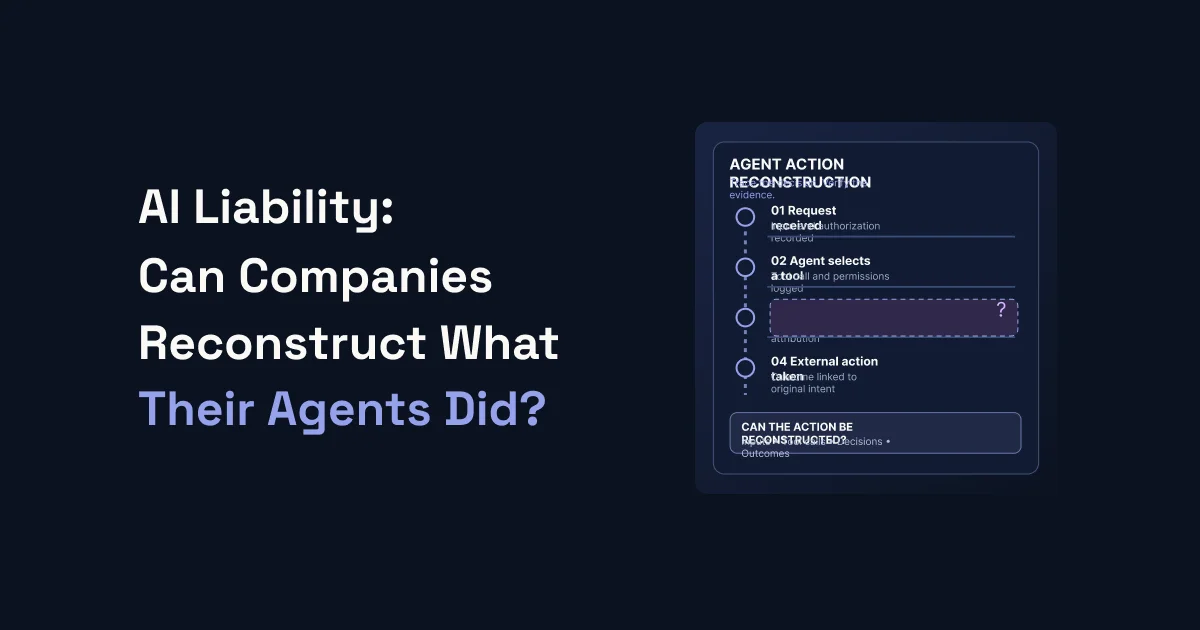
AI Liability: Can Companies Reconstruct What Their Agents Did?
When an autonomous AI agent causes an unexpected outcome, can a company reconstruct its actions? Explore why operational logs, behavioural testing records and pre-incident risk evidence matter for AI liability, incident investigations and insurance reviews.
AI Insurance Exclusions Are Growing. Are Companies Prepared?
AI-related exclusions are emerging across liability insurance policies, raising new questions for companies deploying consequential AI. Understanding policy wording matters, but so does having technical evidence of how AI applications behave, where controls may fail and what exposure remains.