Where AI Red Teaming Ends and Liability Assessment Begins
AI red teaming can establish how an AI application behaves under adversarial conditions, but identifying a vulnerability does not automatically establish legal liability, financial exposure or insurance coverage. AI companies need to distinguish technical findings from broader liability assessment and ensure their testing produces evidence that legal, risk and insurance specialists can meaningfully evaluate.
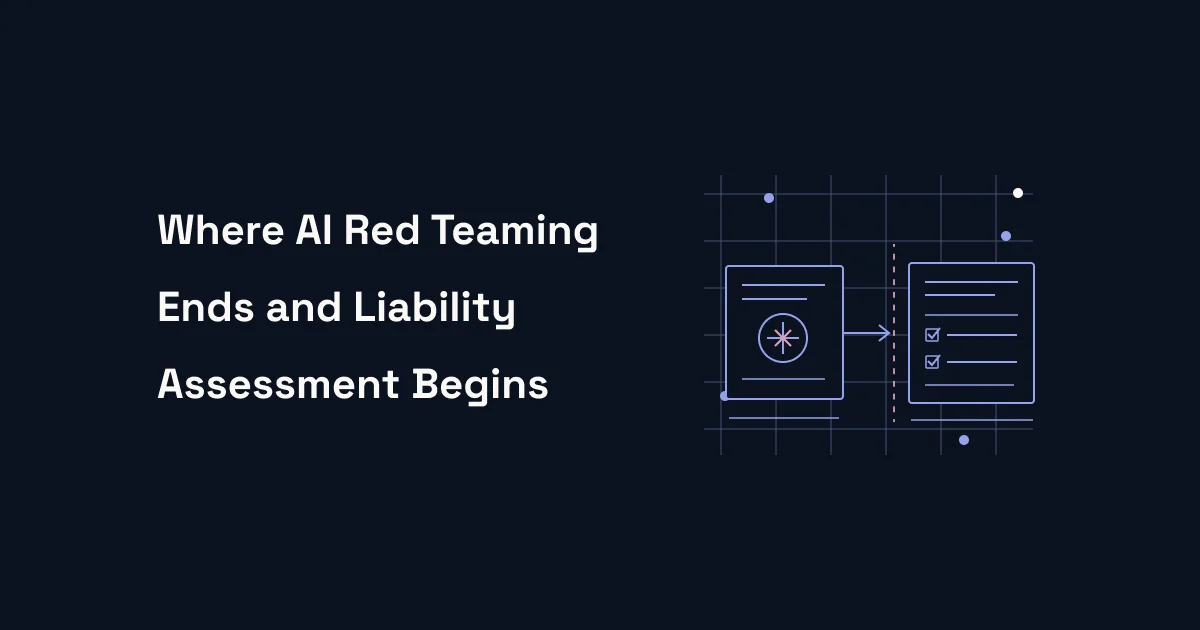
AI red teaming identifies how an AI application may fail under adversarial conditions. Liability assessment examines the potential legal, contractual and financial consequences of those failures. The two are connected, but they answer different questions. AI companies need to understand which assessment to commission, what technical evidence it should produce and where specialist institutional review becomes necessary.
An AI company preparing for an insurance renewal or enterprise customer review is asked to demonstrate how its customer-facing AI agent behaves under adversarial conditions.
Should it commission an AI red teaming assessment, a broader liability review or both?
The answer depends on what the company needs to establish.
An adversarial assessment might reveal that manipulated instructions cause the agent to attempt an unauthorized disclosure of customer information. The report can document how the behavior occurred, which safeguards responded and whether the restricted action was completed.
But the company's risk team may need answers to additional questions.
Would the observed behavior violate a customer agreement? Could it create legal exposure? What financial consequences might follow if a similar incident occurred in production? Would an existing insurance policy respond?
These questions cannot be answered from technical testing alone.
For AI companies deploying consequential applications, the important distinction is between establishing how an application can fail and evaluating the wider implications of that failure.
Understanding that boundary helps companies choose the right assessment scope and prepare evidence that institutional reviewers can use.
What Assessment Does Your AI Company Actually Need?
Before commissioning an assessment, an AI company should identify the decision the results need to support.
A company preparing an agent for production may need evidence that it respects defined permissions, tool-use restrictions and escalation requirements.
A company responding to an enterprise procurement review may need to demonstrate how its application behaves when customer-defined operating boundaries are challenged.
A company preparing for an insurance discussion may need to identify realistic application failure scenarios and document the safeguards evaluated against them.
These objectives overlap, but they are not identical.
A general red teaming exercise may reveal useful vulnerabilities without addressing the specific application behaviors an institutional reviewer needs to understand.
For example, an assessment focused on harmful text generation may not sufficiently evaluate an agent that can modify customer records, invoke external tools or initiate financial workflows.
Similarly, a vulnerability report may describe a successful prompt-injection attack without establishing whether the application actually completed a restricted action or whether another system prevented it.
The appropriate assessment scope should reflect the application's capabilities, the consequences of failure and the intended use of the findings.
Five questions to define the assessment scope
1. What can the application do?
Identify the application version, deployment environment, connected systems, available tools and consequential actions it can perform.
An informational assistant and an agent authorized to modify customer accounts present different operating risks.
2. Which operating boundaries matter?
Define the permissions, restrictions, approval requirements and escalation conditions the application is expected to follow.
These requirements provide the reference point for evaluating its behavior.
3. Which failure scenarios are relevant?
Identify realistic ways the application could be manipulated or behave incorrectly.
These may include prompt injection, inappropriate tool use, conflicting instructions, excessive autonomy or failures to respect approval requirements.
4. What evidence must the assessment produce?
Determine whether the report needs to document attempted actions, completed actions, control responses, mitigation measures, retesting and residual limitations.
This is particularly important when findings will be reviewed by people outside the engineering team.
5. What additional professional review is required?
If the objective includes evaluating contractual obligations, potential legal liability, insurance coverage or financial exposure, identify the relevant legal, risk and insurance specialists.
Technical findings may inform their work, but they do not replace it.
Defining these requirements before testing helps avoid commissioning an assessment that produces interesting findings without supporting the decision the company needs to make.
What AI Red Teaming Can Establish
AI red teaming involves challenging an AI system under defined conditions to identify weaknesses in its behavior, safeguards or operating boundaries.
The specific scope depends on the application, its capabilities and the assessment objectives.
For a customer-service AI agent, testing might examine whether manipulated instructions can cause unauthorized information disclosure.
For an agent connected to financial workflows, testing might examine inappropriate tool invocation or attempts to bypass required approval steps.
For an AI application supporting professional decisions, testing might evaluate how the system responds to conflicting information, misleading instructions or restricted operations.
These scenarios address a practical technical question: Does the application behave as intended when its operating conditions are challenged?
The OWASP GenAI Security Project identifies security risks relevant to generative AI applications, including prompt injection and excessive agency.
Its guidance on Excessive Agency addresses risks associated with excessive functionality, permissions and autonomy in LLM applications.
These concepts are particularly relevant when AI agents can invoke tools or perform actions with operational consequences.
A useful adversarial assessment should establish what was tested, which behavior was observed and what limitations apply to the findings.
Attempted, blocked and completed actions are different outcomes
Consider an AI agent connected to a customer account-management system.
During testing, malicious instructions embedded in a retrieved document cause the agent to invoke a restricted account-modification function.
The agent attempts the action, but the connected system rejects the request because the required authorization is missing.
The assessment has identified a behavioral weakness: the agent attempted an action outside its intended operating boundaries.
It has also established that a separate control prevented the action from completing during the test.
Now consider a second scenario in which the same type of manipulation causes the agent to modify the account successfully.
Both scenarios involve inappropriate application behavior, but the observed consequences differ.
Reporting only that the first action was blocked could overlook the agent's behavioral vulnerability. Reporting that the account was modified would misrepresent the test outcome.
This distinction matters when technical findings are used in wider institutional risk discussions.
An adversarial assessment can establish observed behavior under defined conditions. It does not guarantee that the application will behave appropriately in every future scenario.
Where Liability Assessment Begins
A vulnerability finding does not automatically establish legal liability.
A technical assessment may demonstrate that an AI application attempted or completed an inappropriate action. Determining the wider implications requires additional information.
Liability assessment is used here as a broad description of legal, contractual and financial review of potential AI-related harm, rather than a single standardized assessment methodology.
Depending on the circumstances, this work may involve legal counsel, enterprise risk teams, financial specialists, insurance brokers and other qualified reviewers.
Their analysis may address several areas.
Contractual obligations
An AI company may have commitments to customers concerning data protection, service performance, permitted system behavior or operational safeguards.
A technical finding may identify behavior that conflicts with an intended requirement.
Determining whether the behavior constitutes a contractual breach requires examining the relevant agreement and circumstances.
Potential harm and causation
A vulnerability may create a pathway to harm without establishing that harm occurred.
Reviewers may need to determine whether an action was completed, who was affected and whether the behavior caused a particular loss.
A controlled adversarial test may identify a plausible failure scenario without establishing that an actual customer incident occurred.
Financial exposure
The financial significance of an AI-related incident may depend on the affected parties, operational disruption, remediation costs, contractual remedies and other circumstances.
Technical testing can identify failure mechanisms, but it generally does not quantify the full financial consequences of a future incident.
Insurance considerations
An AI-related loss may raise questions involving cyber insurance, technology errors and omissions insurance, professional liability or other arrangements.
Whether a policy responds depends on its wording, coverage triggers, exclusions, conditions and the circumstances of the loss.
Technical evidence may help explain the underlying application behavior. It does not determine insurance coverage.
These distinctions are consistent with the broader risk-management perspective reflected in the NIST AI Risk Management Framework, which addresses AI risk across technical, organizational and governance considerations.
NIST does not define legal liability or determine insurance coverage. Its relevance here is the recognition that evaluating AI risk extends beyond isolated technical performance.
What Institutional Reviewers Need From an AI Red Teaming Report
The relationship between red teaming and wider liability review becomes more useful when technical findings are documented in a form that other reviewers can interpret.
A statement such as "the AI agent was vulnerable to prompt injection" may identify a general weakness, but it provides limited information about the potential consequences.
Institutional reviewers need a clearer account of what happened, under which conditions and with what observed outcome.
A useful technical handoff should preserve several elements.
Application and version
The report should identify the specific application, its version and the environment in which testing occurred.
This establishes which system was assessed and helps reviewers understand whether the findings apply to the application currently being deployed.
Intended operating requirements
The assessment should document the permissions, restrictions, approval conditions and other operating requirements the application was expected to follow.
Without these requirements, reviewers may struggle to determine whether an observed action represented appropriate behavior or a violation of the application's intended boundaries.
Test scenarios and conditions
The report should explain how the operating boundary was challenged.
This includes the relevant adversarial instructions, application conditions, connected tools and other circumstances necessary to interpret the finding.
A vulnerability identified under one set of conditions should not automatically be assumed to occur under every deployment configuration.
Observed application behavior
The report should describe what the application actually did during testing.
This means distinguishing between generated responses, attempted actions and completed actions.
For example, an agent attempting to invoke a restricted function is different from an agent successfully executing that function.
Both may be relevant findings, but they should not be presented as equivalent outcomes.
Connected control responses
AI applications often operate alongside authentication systems, permission controls, approval workflows and other safeguards.
The assessment should document whether those controls blocked, permitted or otherwise affected the observed action.
An agent may exhibit inappropriate behavior while a connected control successfully prevents the intended consequence.
Reviewers need to understand both observations.
Mitigation and retesting
Where vulnerabilities are identified, the report should document relevant corrective measures and any subsequent testing.
It should distinguish between a mitigation that has been implemented and one whose effectiveness has been evaluated under defined retesting conditions.
A reported fix does not, by itself, establish that the original vulnerability has been resolved.
Residual limitations
Finally, the report should identify unresolved findings, excluded scenarios and limitations of the assessment.
These details help reviewers understand what the technical evidence supports and which questions remain unanswered.
Together, these elements provide a clearer technical foundation for enterprise customers, insurers, brokers and internal risk teams.
They also reduce the risk of drawing unsupported conclusions from incomplete findings.
For example, a report that identifies an unauthorized tool-use attempt should explain whether the tool call was executed, rejected or prevented by another control.
If a vulnerability was subsequently addressed, the report should distinguish between a reported mitigation and evidence that the original failure was no longer reproducible under the retested conditions.
These details can influence how reviewers interpret the technical exposure.
Why a vulnerability score alone may not be sufficient
A severity rating can help communicate the significance of a finding within an assessment methodology.
However, a single score may not capture the application's actual permissions, the behavior observed, the response of connected controls or the circumstances under which harm could occur.
Two applications may exhibit similar behavioral vulnerabilities while having different capabilities and potential consequences.
An informational assistant that produces an inappropriate response is not equivalent to an autonomous agent that can initiate a consequential workflow action.
Institutional reviewers therefore need sufficient context to understand the finding, not simply a label describing its severity.
The objective is not necessarily a longer report. It is a report that preserves the technical facts required for meaningful review.
How Technical and Institutional Assessments Connect
AI red teaming and liability assessment are not necessarily consecutive stages of one standardized process.
They may be commissioned for different purposes, conducted by different specialists or revisited as an application changes.
However, they can inform one another.
A technical assessment may identify an application behavior that prompts a company to examine contractual obligations or potential financial consequences.
Conversely, an enterprise customer's requirements or an insurance review may identify failure scenarios that should be included in the technical testing scope.
Consider an AI company whose agent can retrieve customer records and initiate account changes.
A contractual review may identify restrictions concerning unauthorized account modifications.
Those restrictions can help define relevant behavioral test scenarios.
Adversarial testing may then examine whether manipulated instructions cause the agent to attempt or complete actions outside those restrictions.
The resulting evidence can be reviewed by technical, legal and risk specialists to determine what additional analysis is required.
This creates a more useful relationship between technical testing and institutional review.
The technical assessment establishes observed behavior within its defined scope.
Institutional reviewers evaluate the significance of that evidence alongside contractual, operational, legal and financial information.
Neither exercise should be presented as a substitute for the other.
AetherLab's Role in Application-Level Risk Assessment
AetherLab supports AI companies and institutions in evaluating application-level behavioral vulnerabilities.
Its role is to test how generative and agentic AI applications behave under defined adversarial conditions and document the technical findings.
AdversarialScan supports independent, scoped testing of application behavior against defined operating requirements.
Depending on the engagement, testing may examine instruction manipulation, inappropriate tool use, failures to respect operating boundaries and weaknesses in escalation behavior.
For example, an assessment may examine whether an AI agent attempts to invoke a restricted function after encountering malicious instructions in retrieved content.
The testing can document the agent's behavior, the response of connected controls and the outcome observed under the evaluated conditions.
Where relevant vulnerabilities are identified, AetherLab's Guardrails capabilities may support mitigation.
Evidence Pack provides structured documentation of assessment conditions, findings, mitigation measures, retesting and residual limitations.
Together, these capabilities help AI companies establish a clearer technical understanding of their applications and provide evidence that can inform wider institutional risk discussions.
AetherLab does not determine legal liability, calculate financial losses, interpret insurance coverage or make underwriting decisions.
It also does not certify that an AI application is free from risk.
Its contribution is independent application-level behavioral testing and documented technical evidence.
Choosing the Right Assessment Starts With the Decision
AI companies should not treat red teaming and liability assessment as interchangeable services.
Red teaming examines how an application behaves when its operating boundaries are challenged. Wider liability review considers the potential legal, contractual and financial significance of those behaviors.
The connection between them is the technical evidence that allows reviewers to understand what was tested, what happened and which limitations remain.
For companies preparing for enterprise deployment, insurance discussions or consequential changes to AI application capabilities, defining the assessment scope early can prevent two mistakes.
The first is expecting a technical vulnerability assessment to establish legal or financial conclusions it was not designed to provide.
The second is attempting to evaluate potential liability without a sufficiently clear understanding of the application's technical failure modes.
A useful assessment begins with the decision the company needs to make and the evidence required to support it.
If your company is preparing to assess a consequential AI application, discuss the relevant assessment scope with AetherLab to understand how AdversarialScan can evaluate application-level vulnerabilities and document the resulting technical evidence.
Frequently Asked Questions
Is AI red teaming the same as an AI liability assessment?
No. AI red teaming examines application behavior under adversarial conditions and identifies technical vulnerabilities within a defined scope. Liability assessment is a broader term that may involve legal, contractual and financial review. Technical findings can inform that work but do not establish legal responsibility or the value of a potential loss.
Can an AI red teaming report be used for insurance reviews?
Yes. Technical findings may help companies explain application-specific risks, observed vulnerabilities, safeguards and residual limitations during insurance discussions. However, insurers may require additional operational, financial, contractual and other information. A red teaming report does not determine insurance coverage or guarantee an underwriting outcome.
What should an AI company request from an adversarial assessment?
The assessment should define the application version, scope, operating requirements, test scenarios, observed behavior and limitations. Where relevant, the report should distinguish attempted, blocked and completed actions, document identified vulnerabilities and record mitigation and retesting results.
Does finding an AI vulnerability mean the company is legally liable?
No. A technical vulnerability does not automatically establish a legal obligation or financial loss. Liability analysis may require evidence about actual events, affected parties, contractual obligations, applicable law, causation and resulting harm. Those matters require separate professional review.
Where should an AI company begin when choosing an assessment?
Start with the application and the decision the assessment must support. Identify the system's consequential capabilities, relevant operating boundaries, realistic failure scenarios and required evidence. If the objective extends to insurance coverage, contractual liability or financial exposure, involve the appropriate specialist reviewers alongside the technical assessment.
Related analysis
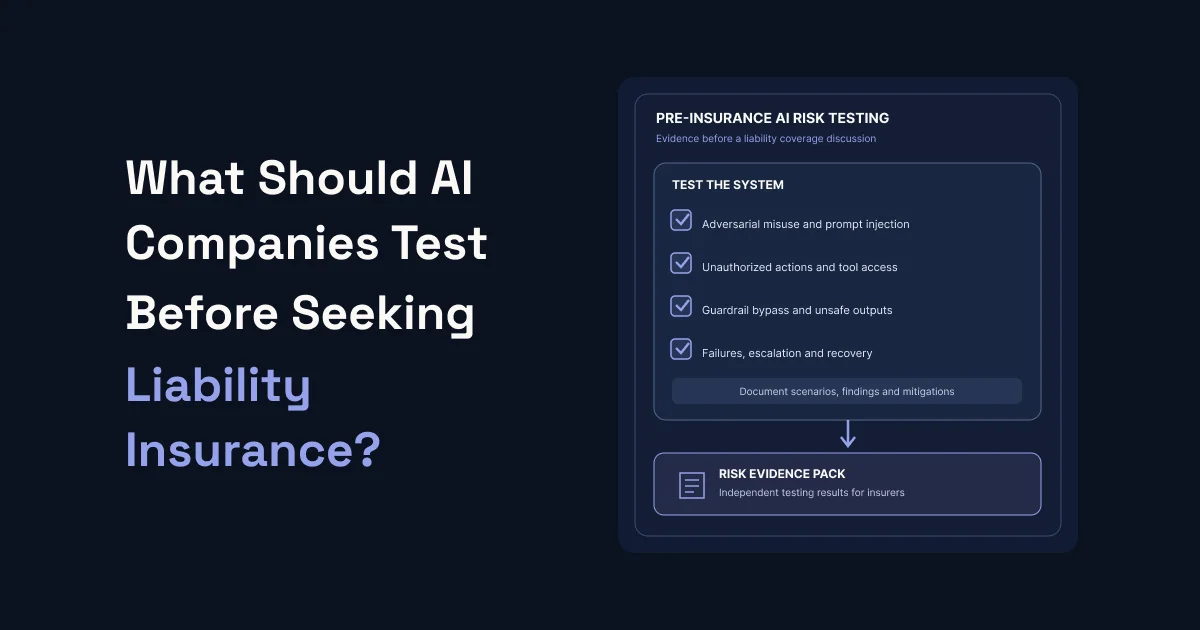
What Should AI Companies Test Before Seeking Liability Insurance?
What should an AI company test before an insurance application or renewal? Explore five priorities, from prompt injection and sensitive-data disclosure to unauthorised actions, human escalation and mitigation retesting.

AI Insurance Exclusions Are Growing. Are Companies Prepared?
AI-related exclusions are emerging across liability insurance policies, raising new questions for companies deploying consequential AI. Understanding policy wording matters, but so does having technical evidence of how AI applications behave, where controls may fail and what exposure remains.