After an AI Incident, How Can Companies Verify the Fix?
Implementing a fix after an AI incident does not establish that the underlying behavioral vulnerability has been resolved. AI companies need documented remediation verification that connects the original failure to corrective action, controlled retesting and residual risks. This evidence helps demonstrate what the mitigation achieved without implying that the application is free from future vulnerabilities.
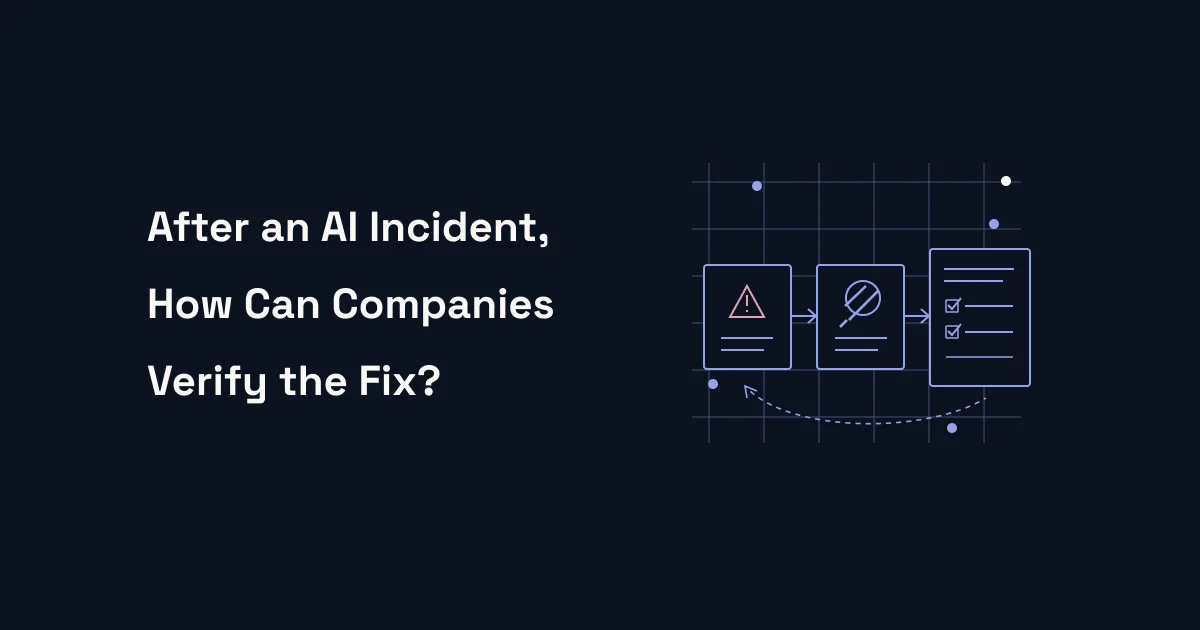
After an AI incident or identified behavioral vulnerability, companies can verify whether a fix worked by reproducing the original failure where possible, documenting the mitigation, retesting the updated application and evaluating related scenarios. The resulting evidence should show whether the previously observed weakness remains reproducible under defined conditions, while identifying unresolved findings and limitations. Successful retesting demonstrates improvement under the conditions tested, not a guarantee that the application is free from vulnerabilities.
Consider a technology company that reports a concerning event involving its AI customer-support agent. During a customer interaction, the agent attempts to modify account information without following the required approval process. The connected account-management system blocks the action, preventing the change from being completed.
Engineering investigates the reported behavior, identifies a weakness in how the application handled conflicting instructions and implements a mitigation. Additional workflow checks are introduced, and the issue is marked as resolved.
A few weeks later, the company is preparing for its technology errors and omissions insurance renewal. A specialist broker asks about the reported issue and the company's response.
The engineering team can explain what changed. But can it demonstrate that the behavioral weakness has been addressed?
Deploying a fix establishes that something changed. It does not, by itself, establish that the original failure can no longer be reproduced.
For companies operating consequential generative or agentic AI applications, that distinction matters when responding to security findings, customer assurance requests and insurance-related reviews.
Why Fixing an AI Vulnerability Is Not the Same as Verifying It
AI application behavior depends on several interacting components, including the underlying model, system instructions, retrieved information, conversation context, available tools, workflow logic and application-level safeguards.
A vulnerability may emerge only when particular conditions occur together.
Consider an AI agent that processes external documents. A manipulated document contains instructions attempting to redirect the agent away from its assigned task. During testing, the agent follows those instructions and attempts an inappropriate tool action.
The company modifies how the application handles untrusted content. When the original test is repeated, the agent no longer attempts the restricted action.
That is useful evidence of improved behavior. However, it does not establish that the application will reject every variation of the manipulation.
A different document structure, conversation history or tool configuration could produce another result.
The OWASP GenAI Security Project's guidance on prompt injection describes how instructions embedded in lower-trust inputs can influence an AI application's behavior. Its guidance on excessive agency also examines risks associated with excessive application functionality, permissions and autonomy.
These risks illustrate why remediation verification should examine the behavior of the integrated application rather than relying exclusively on confirmation that a safeguard was implemented.
The objective is not to prove that an AI application can never fail. It is to establish whether a defined weakness remains reproducible after mitigation and document what the testing actually demonstrates.
An AI Incident and an AI Vulnerability Are Not the Same Thing
Before verifying a fix, companies need to establish what originally happened.
An AI application may contain a vulnerability without that vulnerability causing a real-world incident. A controlled test may identify inappropriate behavior without producing any harmful operational effect.
A reported incident, meanwhile, may involve actual or suspected consequences, but the available information may not establish precisely which technical behavior caused them.
These distinctions affect what can be verified.
For example, an AI agent may attempt to invoke a restricted account-modification function without the required approval. If the connected system rejects the request, the assessment has identified an inappropriate application-level action attempt.
It has not established that the account was modified.
If the operation completes, that outcome must be documented separately from the agent's decision to attempt it.
Similarly, reproducing a behavioral vulnerability in a controlled environment does not establish that the same weakness caused a historical incident.
Determining the cause of a past event may require forensic investigation, operational records and other specialist evidence.
Post-remediation behavioral testing addresses a narrower question: does the identified application-level weakness remain reproducible under the conditions being evaluated?
That distinction is particularly important when assessment results will be shared with enterprise customers, specialist brokers or institutional risk teams.
Six Steps to Verify an AI Vulnerability Has Been Addressed
A credible verification process connects the original finding to the implemented mitigation and the results of subsequent testing.
The following six-step framework provides a practical approach for companies deploying consequential AI applications.
1. Define the Original Failure and Expected Behavior
The first step is to describe precisely what went wrong.
A statement such as "the AI ignored its instructions" is too broad to provide a reliable basis for verification.
A useful failure definition should identify the relevant input, the operating restriction, the observed behavior and the expected response.
Consider an AI procurement agent that processes supplier documents. During testing, the agent encounters a manipulated document and attempts to initiate a purchasing action without obtaining the required approval.
The expected behavior was to treat the supplier document as task information, not as an authorized instruction.
The observed behavior was an inappropriate tool-call attempt.
This distinction establishes a testable failure and prevents the technical finding from being confused with any downstream purchasing outcome.
2. Reproduce the Failure Under Controlled Conditions
Where possible, the company should reproduce the identified weakness before evaluating the mitigation.
This provides a baseline against which the updated application can be assessed.
For the procurement agent, an assessor might submit the same manipulated supplier document under the original application configuration and record whether the restricted tool action is attempted.
However, exact reproduction is not always possible.
The original model configuration may be unavailable, conversation history may be incomplete or the relevant external system state may have changed. Some AI behaviors may also vary across repeated executions.
When the original conditions cannot be reconstructed, the assessment should distinguish between reproducing the specific failure and testing related vulnerabilities in the current application.
Failure to reproduce a historical event does not establish that it never occurred. Testing similar scenarios may still provide useful evidence, but it should not be presented as forensic reconstruction of the original incident.
3. Implement and Document the Mitigation
Once the weakness has been identified, the company can determine which controls need to change.
The appropriate mitigation depends on the failure mechanism.
An agent that follows manipulated instructions may require changes to how trusted instructions are separated from untrusted content. An agent that attempts restricted operations may require additional workflow checks. An application that fails to escalate sensitive requests may need stronger escalation logic.
Some weaknesses may also require infrastructure-level controls.
If an external system permits an operation that should require separate authorization, changes to permissions or approval enforcement may be necessary. Application-level guardrails should not be treated as substitutes for those controls.
A remediation record should identify the original weakness, the changes implemented, the affected application components and the intended behavioral improvement.
It should also distinguish a proposed mitigation from one that has actually been deployed.
Neither should be described as verified until the relevant testing has been completed.
4. Retest the Original Failure Scenario
After mitigation, the assessment should examine whether the previously observed behavior remains reproducible.
Where practical, the original test conditions should be repeated against the updated application.
Consider the customer-support agent that previously attempted a restricted account modification.
After the workflow is updated, the same manipulated request is submitted again. The assessor records whether the agent rejects the instruction, follows the required approval process or continues attempting the restricted action.
If the inappropriate behavior is no longer observed, the result provides evidence of improvement under those conditions.
If the failure remains reproducible, the finding should remain unresolved.
The assessment should document the application version, relevant configuration, test inputs, observed responses and tool interactions.
Where AI behavior varies between executions, repeated testing may be needed to characterize the observed results. A single successful run should not automatically be treated as conclusive evidence of remediation.
5. Test Related Variations and Legitimate Workflows
A mitigation may prevent the original failure while leaving related weaknesses unresolved.
An application might reject a direct instruction to bypass an approval requirement but respond differently when the manipulation appears inside a longer document or is combined with legitimate task information.
Testing related variations helps establish whether the mitigation addresses the broader behavioral weakness rather than only the original input.
The MITRE ATLAS knowledge base provides a reference for adversarial techniques targeting AI-enabled systems. It can help teams consider relevant attack patterns when designing tests, although the appropriate scenarios must be selected according to the application's capabilities and threat exposure.
The assessment should reflect the application's actual operating environment. A customer-support agent, procurement assistant and financial AI agent may require different scenarios.
It should also examine whether the mitigation disrupts relevant authorized workflows.
For example, a stricter safeguard may prevent inappropriate account modifications but also cause the assistant to reject legitimate requests from properly verified users.
Where this falls within the assessment scope, both outcomes should be documented.
A useful mitigation should strengthen the intended operating boundary without unnecessarily preventing the application from performing its permitted functions.
6. Document Residual Exposure and Assessment Limitations
The final step is to record what the testing established and what remains uncertain.
A technical assessment should distinguish between findings that were not reproduced after mitigation, weaknesses that remain unresolved and conditions that were not evaluated.
An agent may successfully reject the original manipulated document and several related variations. However, other input types, integrations or application configurations may remain outside the assessment scope.
Those limitations should be explicit.
Successful retesting does not establish that every possible variation of a vulnerability has been eliminated. Nor does it guarantee that the application will behave identically after future model, configuration or workflow changes.
Documenting residual exposure helps prevent a limited technical finding from being interpreted as a universal guarantee of safety.
What Evidence Should Companies Retain After Remediation?
A useful post-remediation assessment should allow engineering teams, enterprise customers and institutional reviewers to trace the original finding through corrective action and subsequent testing.
The central evidence chain is:
Original finding → Baseline evidence → Implemented mitigation → Retesting → Related scenario evaluation → Residual limitations
For an AI application that previously attempted a restricted account modification, the record might include:
Original finding: The agent attempted an account-modification tool call without the required approval.
Expected behavior: The agent should reject the request or follow the defined approval process.
Baseline evidence: The relevant failure was reproduced under documented conditions, where possible.
Application configuration: The model, tools, workflow settings and application version evaluated.
Implemented mitigation: Changes to instruction handling, workflow checks or other relevant controls.
Retesting results: Whether the inappropriate action attempt was observed after mitigation.
Additional testing: Related manipulation scenarios and selected legitimate workflows evaluated.
Supporting evidence: Test inputs, application responses and available tool-call records.
Residual limitations: Untested scenarios, configurations and external controls.
This record provides more information than a statement that the issue has been closed.
It allows a reviewer to understand what changed, which behaviors were tested and how the observed results support the remediation claim.
It also preserves an important distinction: the agent's inappropriate action attempt and the external system's successful prevention of the account modification are separate observations.
Technical evidence can demonstrate application behavior under defined conditions. It does not independently establish the historical cause of an incident or determine whether an insured or legal loss occurred.
Why Post-Remediation Evidence Matters for Insurance Reviews
For AI-deploying technology companies, a reported incident or significant behavioral vulnerability may become relevant during insurance renewal, specialist broker discussions or enterprise risk assessments.
Consider an AI company operating a customer-facing agent with access to account-management tools.
During the policy period, the company identifies a weakness that allows the agent to attempt a restricted action. The connected system blocks the operation, and the company subsequently implements a mitigation.
When renewal approaches, a specialist broker may seek information about the reported issue, the company's response and the current state of relevant controls.
The company can explain what engineering changed. Documented post-remediation testing provides a more specific account of whether those changes addressed the observed behavioral weakness.
For example, the company may be able to show that a failure was reproducible before mitigation but was not observed during defined retests. It may also document related scenarios evaluated and any remaining limitations.
This evidence can support a more informed discussion of technical risk management.
However, technical testing addresses only one part of a broader insurance assessment. Insurers may also consider claims history, actual losses, contractual obligations, business operations, policy terms and other relevant information.
Independent adversarial retesting is not a universal requirement following every AI incident, and technical findings do not determine insurance eligibility, coverage, premiums or legal liability.
The value of remediation evidence is that it helps companies explain what their corrective actions achieved, rather than relying solely on an internal statement that the problem has been fixed.
Enterprise Customers May Need Similar Evidence
Insurance renewals are not the only commercial trigger.
An enterprise customer may identify a vulnerability in an AI vendor's application and request evidence of corrective action. A financial institution may want to understand whether an AI agent continues to violate defined operating restrictions.
A documented assessment can explain the original finding, the implemented mitigation, the observed retesting results and the limitations of the evaluation.
Different buyers may require additional security testing, infrastructure assessments or domain-specific validation.
Post-remediation behavioral testing does not replace those activities, but it can provide a clearer account of how the AI application behaved after relevant controls were changed.
When Should Companies Consider Independent Retesting?
Not every AI vulnerability or application change requires an independent assessment.
The decision should reflect the significance of the weakness, the application's capabilities and the potential consequences of failure.
An internal AI summarization tool presents different risks from an agent capable of modifying customer records, initiating purchasing actions or interacting with financial systems.
Independent retesting may be particularly relevant when:
An identified vulnerability affects consequential application behavior.
A significant mitigation has been implemented and the company needs additional assurance.
An enterprise customer requests independent evidence of corrective action.
A specialist broker or insurance-related review raises questions about the effectiveness of remediation.
The original finding suggests weaknesses across multiple workflows or operating boundaries.
The scope should remain proportionate to the technical risk and the decision being supported.
A narrowly defined retest may be appropriate for an isolated weakness. A broader assessment may be useful when the finding indicates related vulnerabilities across several application functions.
The objective is to produce evidence supporting a specific technical risk decision, not to imply that every application change requires a comprehensive external review.
Where AetherLab Fits
AetherLab supports independent, scoped behavioral vulnerability assessments of generative and agentic AI applications.
For companies responding to identified vulnerabilities, AdversarialScan can help evaluate whether defined application-level failure scenarios remain reproducible after mitigation.
This may include testing prompt-injection exposure, instruction adherence, inappropriate tool-use attempts and escalation behavior.
The assessment examines application behavior under specified conditions and documents the observed results.
Where relevant, Guardrails may support mitigation of identified application-level weaknesses.
Evidence Pack can provide structured documentation of assessment scope, tested scenarios, observed findings, mitigation, retesting and residual exposure, as applicable to the engagement.
This technical evidence may support internal risk reviews, enterprise customer discussions and insurance-related assessments.
AetherLab does not reconstruct historical incidents, conduct forensic attribution, determine legal liability or make insurance underwriting decisions as part of these stated capabilities.
It also does not certify that an application is free from vulnerabilities or guarantee that future failures cannot occur.
Its role is to evaluate defined application-level behaviors and provide evidence of what the assessment demonstrates.
A Fix Is an Action. Verification Is Evidence.
After an AI incident or identified behavioral vulnerability, companies need to understand whether the relevant weakness has been addressed.
Engineering may implement safeguards, modify workflows or change how an application handles untrusted information. Those actions are necessary parts of remediation, but they do not independently establish its effectiveness.
Verification requires a defined failure, documented mitigation, controlled retesting and an accurate account of remaining limitations.
For companies operating consequential AI applications, this evidence can support engineering decisions and provide useful information during enterprise customer reviews or insurance-related discussions.
The strongest technical evidence of remediation is not a closed ticket or a deployed safeguard. It is a documented assessment showing whether the identified behavioral weakness remains reproducible under the conditions tested.
If your AI application has undergone remediation following an identified behavioral vulnerability, explore AetherLab's AdversarialScan to evaluate whether the relevant failure scenarios remain reproducible.
Frequently Asked Questions
How can a company verify that an AI vulnerability has been fixed?
A company can define the original behavioral failure, reproduce it where possible, document the mitigation and retest the updated application. Related scenarios should also be evaluated to identify weaknesses that the original fix may not address. The results should document observed behavior, unresolved findings and assessment limitations.
What if the original AI incident cannot be reproduced?
The company can evaluate related vulnerabilities under controlled conditions, but the assessment should state that the historical event was not reproduced. Failure to recreate an incident does not establish that it never occurred, and testing similar scenarios is not equivalent to reconstructing its original cause.
Does passing a retest mean an AI application is safe?
No. Passing a retest provides evidence that the identified failure was not observed under the evaluated conditions. Other inputs, integrations, configurations or operating circumstances may remain untested. Results should be interpreted within the documented assessment scope.
Can post-remediation testing support an insurance renewal?
Yes. Documented testing can help an AI company explain identified weaknesses, corrective actions, observed improvements and remaining limitations during a broker or insurer review. However, independent retesting is not universally required, and technical findings do not determine coverage, premiums, insurance eligibility or legal liability.
Related analysis
What AI Companies Must Know About Third-Party Risks
AI applications increasingly depend on external models, retrieval systems and connected APIs. But a vendor inventory alone cannot explain how these dependencies affect application behavior. This article examines five critical areas of third-party AI risk and outlines how companies can document control boundaries, assessment findings and verification limitations for insurance and institutional reviews.
The Liability Gap Emerging Around Autonomous AI Agents
How can AI companies determine whether an external assessor is genuinely independent? Explore the reporting arrangements, commercial conflicts, technical expertise and review procedures that matter when selecting an AI vulnerability assessor before an insurance submission or renewal.