AI in Banking: When Better Performance Comes With Less Transparency
New SAS and FT Longitude research finds that 63% of surveyed banking leaders would consider accepting reduced AI transparency in exchange for stronger performance, returns or liquidity. As banks move toward more autonomous credit, fraud and risk decisions, predictive accuracy alone cannot establish whether AI applications behave reliably or respect operating constraints. Financial institutions need behavioural testing, effective controls and documented risk evidence before expanding AI decision-making authority.
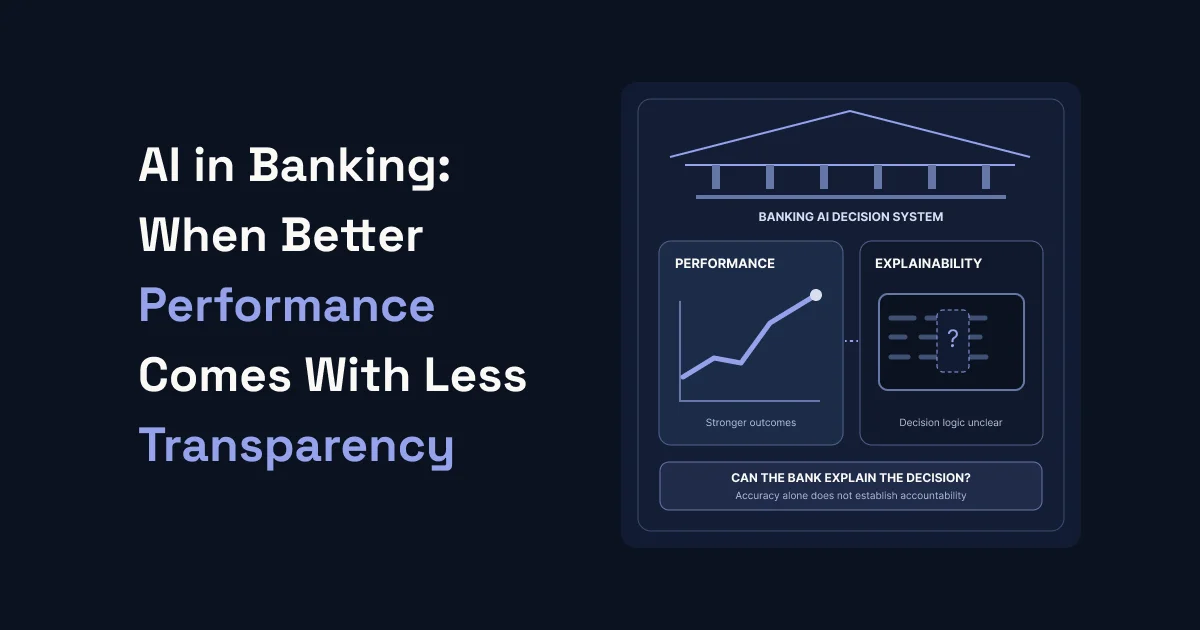
Would a bank accept an AI model it cannot fully explain if that model delivers better financial results?
According to new research from SAS and FT Longitude, many banking leaders would consider doing exactly that.
In a global study published on October 22, 2026, 63% of surveyed banking leaders expressed willingness to use a less transparent black-box AI model if it offered better performance, returns or liquidity than an explainable alternative.
The finding reveals a difficult choice facing financial institutions. AI can improve predictions, accelerate analysis and support increasingly complex decisions. But stronger performance does not automatically establish that a model's decisions are understandable or that the application using those predictions will behave reliably.
As banks expand AI into credit, fraud and risk management, these distinctions become increasingly consequential.
Why Banking Leaders Would Consider Less Transparency
The SAS research, conducted by FT Longitude in June and July 2026, surveyed 300 banking leaders across 31 countries. Approximately two-thirds represented institutions with more than $50 billion in assets.
The 63% finding reflects respondents' stated willingness to consider reduced transparency in exchange for improved results. It does not mean that 63% of banks have already deployed opaque AI in consequential financial decisions.
Nevertheless, it highlights a commercial tension.
Banks operate in environments where relatively small improvements in prediction can have significant financial implications. A model that identifies more fraudulent activity, estimates credit risk more accurately or improves liquidity forecasts may offer meaningful operational value.
An institution comparing two models could therefore face a difficult decision. One may be easier to interpret but produce weaker predictive results. Another may deliver better measured performance while offering less visibility into how individual predictions are generated.
Choosing between them is not simply a technical exercise. It involves determining whether the expected benefits justify the limitations, given the model's intended use, potential consequences and the institution's obligations.
Performance, Explainability and Behavioural Reliability Are Different
The debate is often framed as a choice between accuracy and explainability. In practice, financial institutions need to evaluate three separate properties.
Predictive performance concerns how well a model achieves its statistical objective. In lending, this might involve distinguishing between borrowers with different probabilities of default. In fraud detection, it could involve identifying suspicious transactions while limiting unnecessary declines.
Explainability concerns whether an institution can understand and communicate the factors influencing a model's outputs. Different techniques provide different levels of explanation, and a post-hoc explanation does not necessarily reveal a model's complete internal decision process.
Behavioural reliability concerns how an AI application performs under defined operating conditions, including unusual inputs, conflicting information, manipulated instructions or changes in its environment.
These properties are related, but none automatically establishes the others.
A highly accurate model may behave unpredictably outside its evaluation conditions. An interpretable model may be poorly calibrated. An application may also produce accurate predictions while failing to respect operating constraints when those predictions become part of an automated workflow.
The question is therefore not whether explainability or performance should always take priority. It is whether the institution has sufficient evidence about each property to justify the responsibilities assigned to the AI system.
The Trade-Off Changes When AI Moves From Prediction to Action
The consequences of limited transparency depend partly on what an AI application is allowed to do.
Consider a credit risk model that produces a score for a human underwriter. The score influences a decision, but the institution retains an opportunity to review additional information and apply relevant controls.
Now consider an application that uses AI outputs to initiate or execute decisions automatically.
If the application incorrectly interprets an exception, applies the wrong customer information or fails to respect an approval boundary, the problem may extend beyond predictive accuracy.
The same distinction applies to fraud operations. A model might perform well against historical fraud data, while the surrounding application responds incorrectly to unusual transaction patterns, inconsistent information or attempts to manipulate its inputs.
In both cases, the institution needs evidence about the complete decision workflow, not just the model's performance score.
Automated financial decisions are not inherently inappropriate. Their suitability depends on the use case, applicable requirements, control design and consequences of error.
But increasing an application's authority changes what needs to be evaluated. A model that recommends an action and a system authorised to execute that action present different operational risks, even when they use the same predictions.
Banks Expect More Autonomous Decisions Than They Currently Deploy
The SAS–FT Longitude research illustrates how quickly banking leaders expect this shift to occur.
While only 10% of surveyed institutions reported autonomous credit or risk decisions operating at scale, 76% expected such decisions to operate at scale within five years. A quarter anticipated that transition within two years.
The survey also found that 82% of respondents reported using generative AI for decision-making, while 41% reported using agentic AI.
These figures describe different levels of adoption. Using AI to inform a decision is not equivalent to allowing an autonomous application to execute one independently.
The research also identified limitations in existing oversight capabilities.
Only 18% of respondents reported fully operational, embedded AI governance processes. Just 19% reported real-time AI model drift monitoring, while 42% said their institutions lacked defined mechanisms to deactivate models that cross preset boundaries.
These are self-reported findings, not independently audited assessments of the banks involved.
Nevertheless, they raise a practical concern: institutions expect to delegate more consequential decisions to AI while important monitoring and intervention capabilities remain uneven.
The challenge is determining whether the controls required for a particular application are present, effective and supported by evidence.
What Evidence Should Banks Require Before Expanding AI Authority?
An institution considering a less interpretable model needs more than a comparison of performance metrics.
It should establish what the model is intended to do, which decisions it influences and whether those decisions are advisory, supervised or autonomous.
The next question concerns the conditions under which the application remains reliable.
For a lending workflow, evaluation might examine how the system handles incomplete applicant information, contradictory data, unusual borrower circumstances or cases requiring human escalation.
For a fraud investigation application, testing could examine whether manipulated case information affects its conclusions or whether it respects restrictions on actions it can recommend or initiate.
For an autonomous financial workflow, assessment may also need to examine tool permissions, approval requirements, exception handling and conditions that should trigger intervention.
These evaluations complement statistical validation, explainability analysis, fairness testing and ongoing monitoring. They do not replace those disciplines.
Scenario-based testing can reveal how an application behaves under selected conditions. It cannot make an opaque model fully interpretable, demonstrate reliability across every possible input or guarantee that future decisions will be correct.
The institution must also document the limitations of its assessments. A favourable result from one evaluation should not be treated as evidence that every relevant risk has been resolved.
How AetherLab Supports Evidence-Based AI Risk Decisions
AetherLab helps institutions evaluate and document behavioural risks in generative and agentic AI applications, particularly where those systems operate within consequential workflows.
Its AdversarialScan capability supports independent testing against defined risk scenarios, including instruction manipulation, behavioural boundaries and inappropriate tool use where relevant to the application.
For financial institutions deploying AI-enabled applications, these assessments can provide evidence about how a system responds when its operating constraints are challenged.
AetherLab's Evidence Pack helps organise technical findings, severity assessments, business-impact considerations, mitigation measures and residual risk information for review.
These capabilities do not explain every internal mechanism of a black-box model, validate creditworthiness or determine whether a financial decision should be approved.
Their contribution is helping institutions evaluate and document application-level behaviours that conventional performance metrics may not reveal, providing additional evidence for model risk, product, compliance and operational teams.
Better AI Performance Should Come With Better Risk Evidence
The SAS–FT Longitude findings do not establish that banks are abandoning transparency. They reveal that many leaders are willing to consider a trade-off when the expected performance benefits are compelling.
That willingness is understandable. Financial institutions cannot ignore advances that may improve risk prediction, operational efficiency or customer outcomes.
But better performance is only one dimension of a consequential AI system.
As banks move from AI-assisted analysis toward increasingly autonomous decisions, they need to understand how applications behave, what constraints govern their actions and where human intervention remains necessary.
The objective should not be to reject powerful models simply because they are difficult to interpret. It should be to establish whether their benefits, limitations and operational risks are sufficiently understood for the responsibilities they receive.
Better AI performance is not enough to justify greater decision-making authority. Banks need evidence that AI applications operate within defined risk boundaries, that critical controls have been tested, and that residual risks are understood before expanding their responsibilities.
Explore AetherLab's Evidence Pack to turn technical AI risk findings into documented evidence that supports institutional risk decisions.
Related analysis
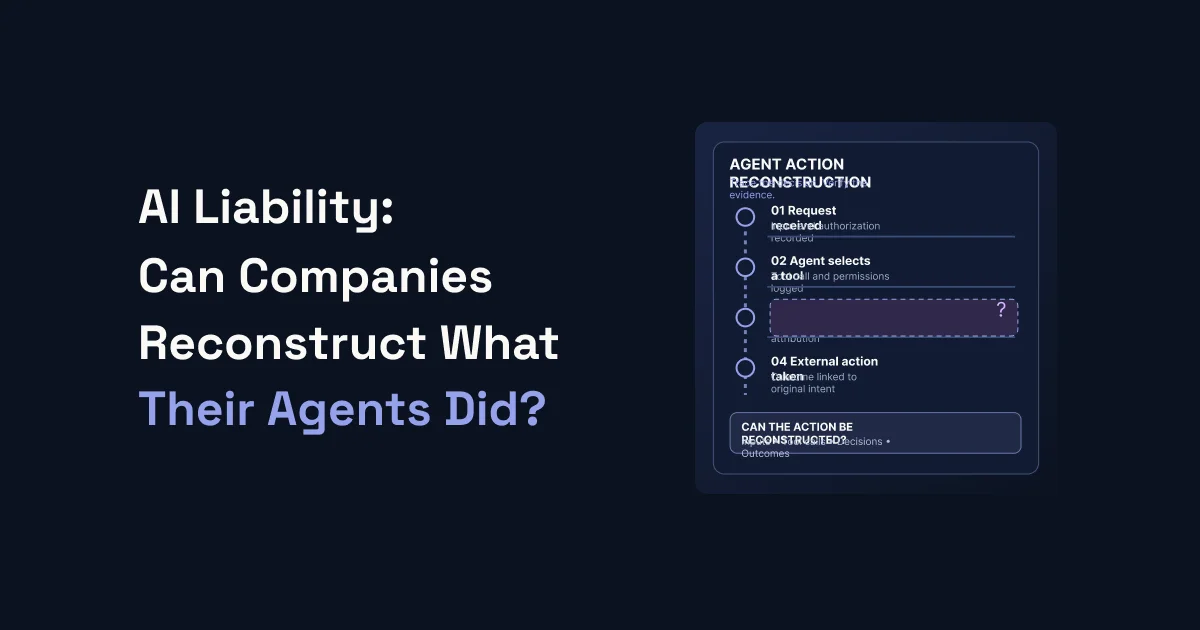
AI Liability: Can Companies Reconstruct What Their Agents Did?
When an autonomous AI agent causes an unexpected outcome, can a company reconstruct its actions? Explore why operational logs, behavioural testing records and pre-incident risk evidence matter for AI liability, incident investigations and insurance reviews.

What PCI's New AI Guidance Means for Payment Institutions
PCI SSC's new guidance highlights the growing security challenges of AI in payment environments. For banks, payment processors and financial institutions, the next step is understanding how AI systems behave when instructions are manipulated, sensitive information is exposed or operational boundaries are challenged.